Hybrid Threats | Psychological Defence | Strategic Intelligence | Technology & Defence | Modern Warfare | Urban Warfare | Staff Rides | Wargames | China and the Indo-Pacific | the Balkans | Central Asia

Tag: Cognitive warfare

Speaker at the 27th Asia-Pacific Programme for Senior Military Officers (APPSMO)

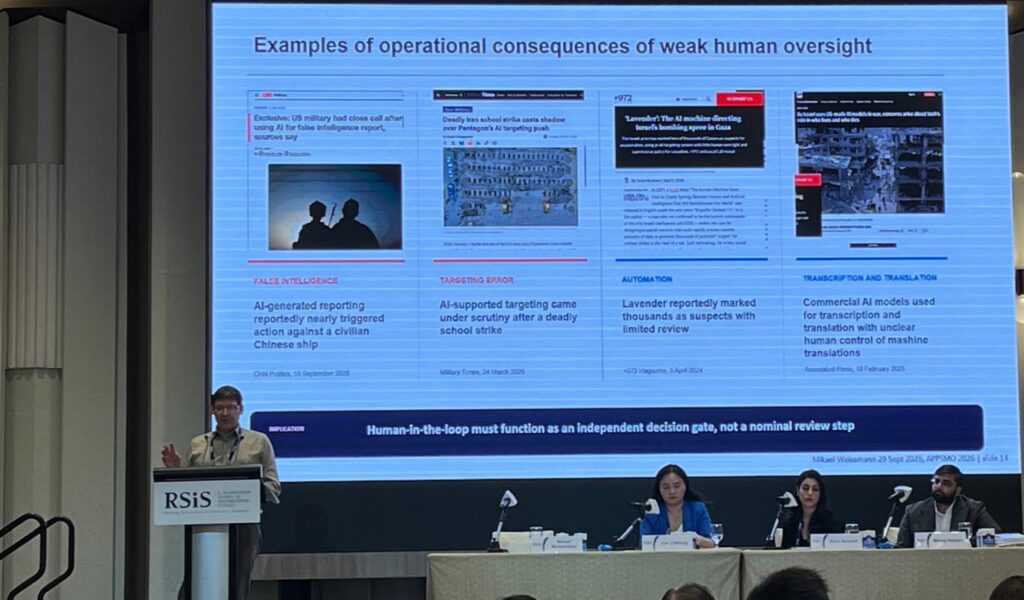
This week, I had the privilege of speaking at the 27th Asia-Pacific Programme for Senior Military Officers (APPSMO) in Singapore, organised by RSIS | S. Rajaratnam School of International Studies.

APPSMO is RSIS’s annual flagship programme for senior military officers and defence professionals. This year, it brought together participants from more than 20 countries under the theme “Security in the Age of Complexity: The Future of Military Affairs”.

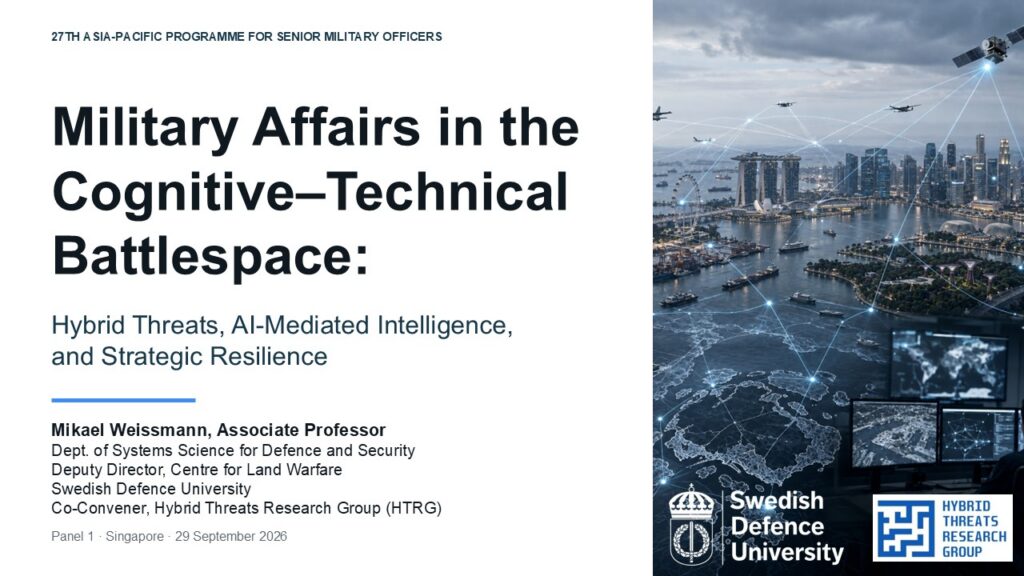
My presentation, “Military Affairs in the Cognitive–Technical Battlespace: Hybrid Threats, AI-Mediated Intelligence, and Strategic Resilience”, examined how technology is reshaping the defence system as a whole.

Many thanks to RSIS, the panel organisers, my fellow speakers and the APPSMO participants for the excellent discussions.

More about APPSMO 2026:

https://rsis.edu.sg/outreach/asia-pacific-programme-for-senior-military-officers-appsmo
Expert Workshop on Collaborative AI-Enabled Sensemaking at USC Capital Campus, Washington, DC

On 25–26 February 2026, I had the pleasure of co-hosting the workshop “Collaborative AI-Enabled Sensemaking: Strategic intelligence in an era of hybrid threats, cognitive warfare, and disinformation” together with Mind-Alliance Systems in Washington, DC. The workshop was held at the USC Capital Campus.

Bringing together senior practitioners working on intelligence and security issues, the workshop explored how AI-enabled collaborative analysis can strengthen strategic intelligence in an increasingly complex threat environment shaped by hybrid threats, cognitive warfare, and disinformation.

A central feature of the workshop was the “Frostbite Fracture” scenario, a realistic grey-zone operations exercise involving Russian hybrid threats to Swedish infrastructure. Within this setting, an AI-enabled decision-support prototype called Sentinel was used to stress-test how intelligence is framed, challenged, disseminated, and acted upon at the intelligence–policy nexus.

The workshop provided an excellent opportunity to examine how human expertise and AI-supported analytical tools can be combined to improve shared situational awareness, sensemaking, and decision support under conditions of uncertainty. It also offered a valuable forum for discussion on the future of strategic intelligence and the practical implications of AI for professional analytical work.

Many thanks to David Kamien & Mind-Alliance Systems, to all participants, and to USC Capital Campus for hosting an engaging and timely workshop.

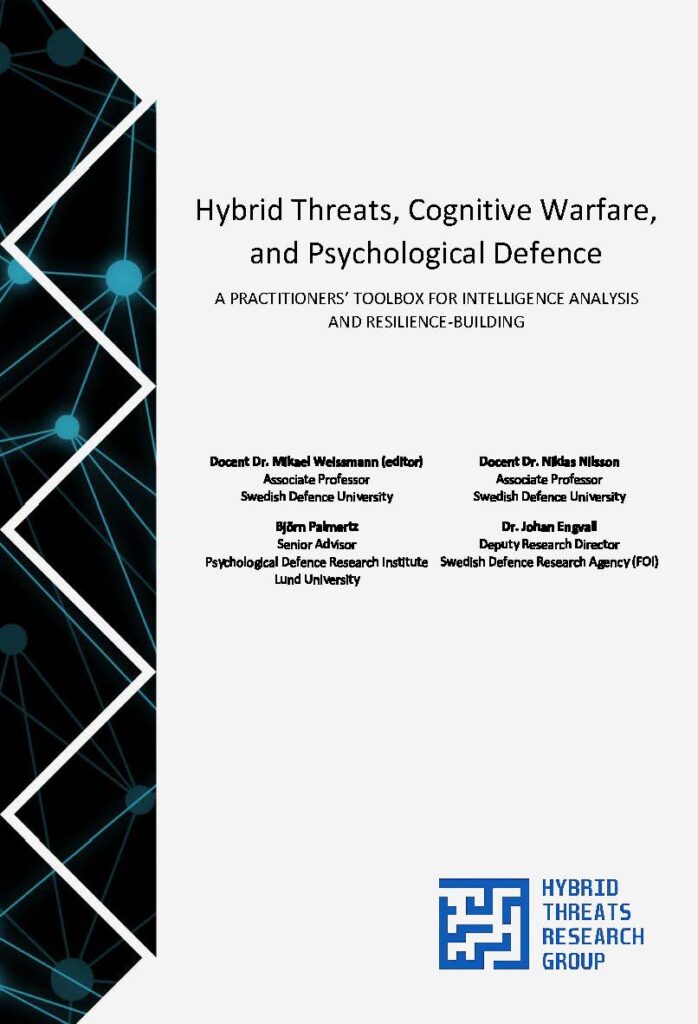
New publication: Hybrid Threats, Cognitive Warfare, and Psychological Defence

A new practitioners’ toolbox, Hybrid Threats, Cognitive Warfare, and Psychological Defence, has been published by the Hybrid Threats Research Group.

The toolbox consolidates key practitioner takeaways from five publications into a single, coherent framework for countering hybrid threats and cognitive warfare and for strengthening psychological defence and societal resilience. It links short-term threat–response cycles with long-term resilience-building and operationalises national-level psychological defence in a ready-to-use format.

The publication integrates three complementary analytical tools:

  • The hybridity blizzard model, illustrating how an aggressor’s targeting of vulnerabilities interacts with defensive responses over time and situating intelligence at the interface between detection, countermeasures, and resilience-building.
  • The intelligence analysis interaction (hourglass) model, capturing the coupled processes of analysis, aggregated and tailored communication, and reception and absorption among societal actors.
  • The assess–address–evaluate (AAE) framework, a six-dimensional structure guiding analysis, action, and learning for psychological defence and resilience.

Together, these tools provide practitioners with a practical workflow for diagnosing hybrid activity, improving intelligence interactions, and strengthening resilience through a coordinated whole-of-society approach.

Powered by WordPress & Theme by Anders Norén