Hybrid Threats | Psychological Defence | Strategic Intelligence | Technology & Defence | Modern Warfare | Urban Warfare | Staff Rides | Wargames | China and the Indo-Pacific | the Balkans | Central Asia

Category: Russia

New Open Access Book: Russia’s War in Ukraine and Modern Warfare

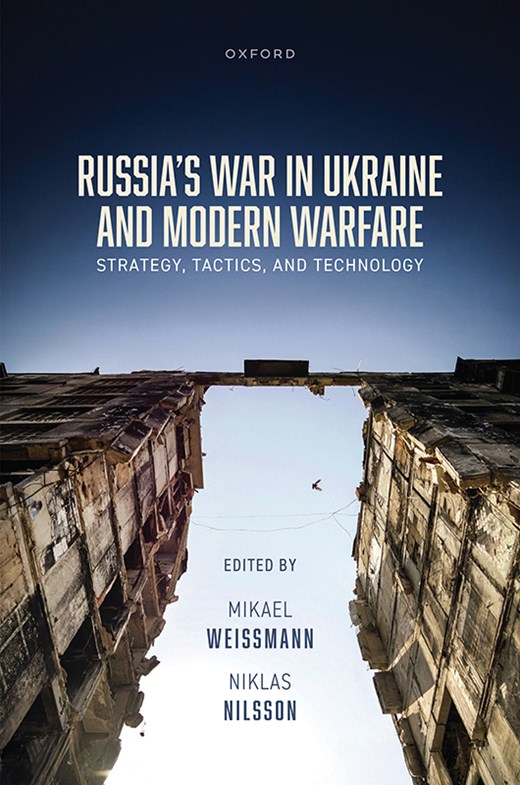
I am delighted to announce the publication of Russia’s War in Ukraine and Modern Warfare: Strategy, Tactics, and Technology, co-edited with Dr Niklas Nilsson and published by Oxford University Press.

Russia’s war in Ukraine is a defining conflict of our time and a watershed in the evolution of modern warfare. It has challenged established assumptions about how wars are fought, sustained, commanded and understood. Our new volume brings together leading scholars and practitioners to examine what the war reveals about both the enduring nature and changing character of warfare.

The book combines thematic analysis with detailed case studies. Its chapters examine:

  • manoeuvre warfare and urban warfare;
  • mission command and command and control;
  • military logistics and health services;
  • air and maritime warfare;
  • force generation and military training;
  • intelligence collection and sharing;
  • drones and other emerging technologies;
  • military learning and adaptation;
  • gender and the Ukrainian armed forces; and
  • key phases of the war between 2014 and 2025.

The volume is structured around four parts: dimensions of modern warfare; organisation, technology and training; chronological case studies; and a concluding assessment of the wider lessons of the war.

In addition to co-editing the volume, I co-authored three chapters:

The book is published Open Access and can be read or downloaded free of charge through Oxford Academic.

Read and download the complete book

The print paperback edition will be published on 30 August 2026 and can be ordered from Oxford University Press.

Reference

Weissmann, Mikael and Niklas Nilsson, eds. Russia’s War in Ukraine and Modern Warfare: Strategy, Tactics, and Technology. Oxford: Oxford University Press, 2026.
https://doi.org/10.1093/9780198970903.001.0001
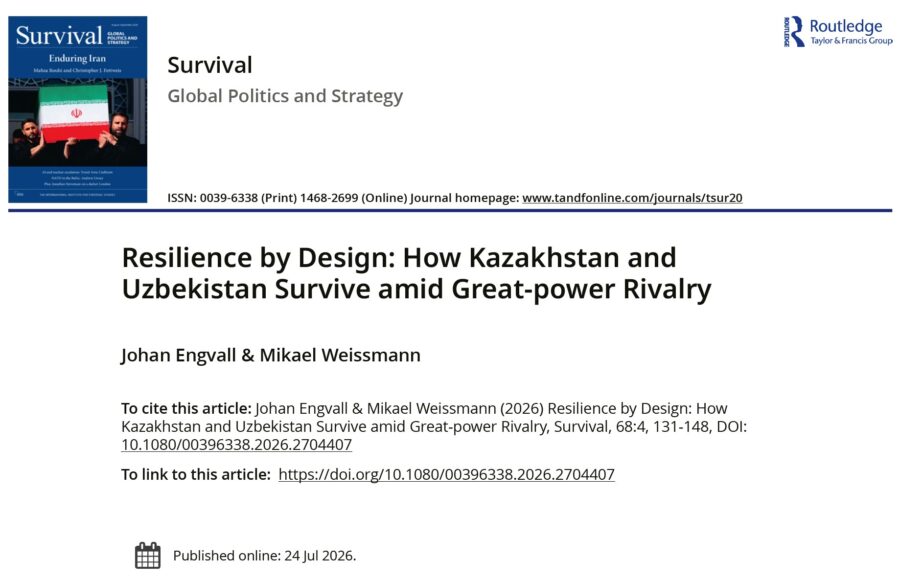
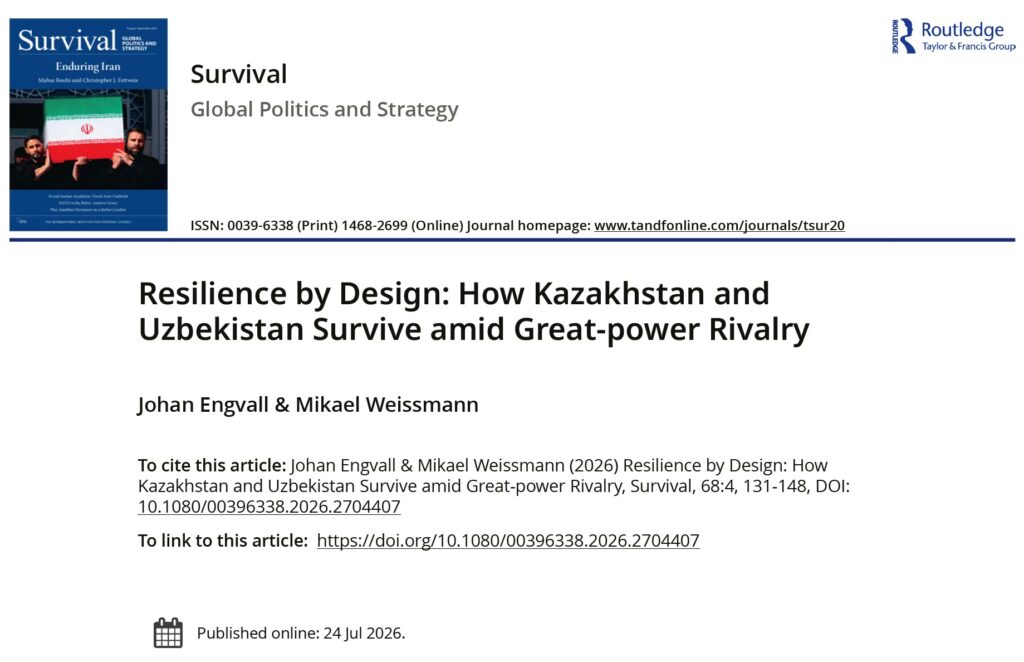
New article: Resilience by Design: How Kazakhstan and Uzbekistan Survive amid Great-Power Rivalry

Why have Kazakhstan and Uzbekistan proved more resilient than many expected amid Russia’s war against Ukraine and intensifying great-power rivalry?

In our new article in Survival, published by the International Institute for Strategic Studies (IISS), Dr Johan Engvall and I argue that this resilience is not accidental. It is resilience by design.

Resilience by Design: How Kazakhstan and Uzbekistan Survive amid Great-Power Rivalry identifies a sovereignty-first strategy built on three mutually reinforcing layers:

• domestic hardening
• regional consolidation
• multi-vector diplomacy

Rather than viewing Central Asian states primarily as passive objects of competition between Russia, China and the West, we show how Kazakhstan and Uzbekistan actively manage dependencies, diversify external relationships and expand their room for strategic manoeuvre.

The article is part of our broader research on hybrid threats, psychological defence and cognitive warfare, conducted through the Hybrid Threats Research Group, and contributes to the project Building Resilience and Psychological Defence: Countering Hybrid Threats and Foreign Influence and Interference, funded by the Swedish Psychological Defence Agency.

Read the article here:
https://www.tandfonline.com/doi/full/10.1080/00396338.2026.2704407

If you do not have access to the full text, send me a message and I will be happy to share an author ePrint link.

New Article: Fågel Fenix: Divisionens strid och taktik i en nutida operativ kontext

I am pleased to share a new article co-authored with Lt Col Dr Lars Henåker, published in Kungl. Krigsvetenskapsakademiens Tidskrift, the journal of The Royal Swedish Academy of War Sciences. The article appears in issue no. 1/2026, which is a theme issue focusing on the army.

In “Fågel Fenix: Divisionens strid och taktik i en nutida operativ kontext” [Phoenix Rising: Division-level Combat and Tactics in a Contemporary Operational Context], we examine the renewed relevance of the division as a command level in the Swedish Army. Against the background of Sweden’s NATO membership, the war in Ukraine, and the increasing complexity of contemporary land warfare, the article asks what the division adds beyond the brigade level and how it can be used in combat.

The article, written in Swedish, examines the renewed relevance of the division as a command level in the Swedish Army. Against the background of Sweden’s NATO membership, the war in Ukraine, and the increasing complexity of contemporary land warfare, we ask what the division adds beyond the brigade level and how it can be used in combat.

Drawing on observations from the Swedish Army Staff Exercise 2022 (ASÖ22), the article analyses division-level command and tactics through eight tactical elements: deployment, aggressive reconnaissance, manoeuvre, breakthrough, high tempo, surprise, shock, and organisational breakdown. We argue that the division has re-emerged as a critical level for coordinating brigades, enabling manoeuvre, sustaining combat power, and creating the conditions for decisive action in a complex operational environment.

Reference:
Henåker, Lars and Weissmann, Mikael, “Fågel Fenix: Divisionens strid och taktik i en nutida operativ kontext”, Kungliga Krigsvetenskapsakademiens Tidskrift, no. 1, 2026, pp. 52–75. Full text.

Expert Round Table on EU, China, and Central Asia

My presentation, “Resilience by Design: How Central Asia Keeps Agency between Brussels and Beijing without Choosing Sides,” highlighted findings on the hierarchy of needs for post-colonial states and introduced a three-layered model of resilience, developed in collaboration with Dr. Johan Engvall (Swedish Defence Research Agency). I also shared concrete policy recommendations on what Europe should—and should not—do in its approach to Central Asia.

Launching new website for the Hybrid Threat Resaerch Group (HTRG) – hybridthreatsresearch.com

The Hybrid Threats Research Group is an interdisciplinary initiative based at the Swedish Defence University, linking scholars and practitioners from political science, strategic communication, war and defence studies, cybersecurity, influence operations, intelligence, and area studies. Our mission is to advance the capacity to identify, analyse and respond to hybrid threats—where conventional and unconventional tactics converge to test social, political and technological resilience.

Guided by a steering group, and supported by a worldwide network of affiliates, we foster international collaboration to build knowledge that supports governments and key societal actors.

Our research focuses on five interconnected themes:

  1. Modern Warfare – examining how technological change reshapes conflict and defence strategy.
  2. Hybrid Threats – exploring the blended tactics of state and non-state actors that erode traditional defence mechanisms.
  3. Strategic Intelligence – strengthening the collection, analysis and application of intelligence to anticipate threats.
  4. Psychological Defence – building societal resilience against disinformation and influence operations across peace, crisis and war.
  5. Defence Systems – bridging social science and engineering to integrate technical and human factors in effective defence solutions.

Through targeted research projects, workshops and seminars, HTRG provides a creative environment for research training, professional development and evidence-based policy advice. We welcome collaboration with academia, government, and industry partners committed to understanding and countering the complex security challenges of today’s interconnected world.

The new website can be found here: https://www.hybridthreatsresearch.com

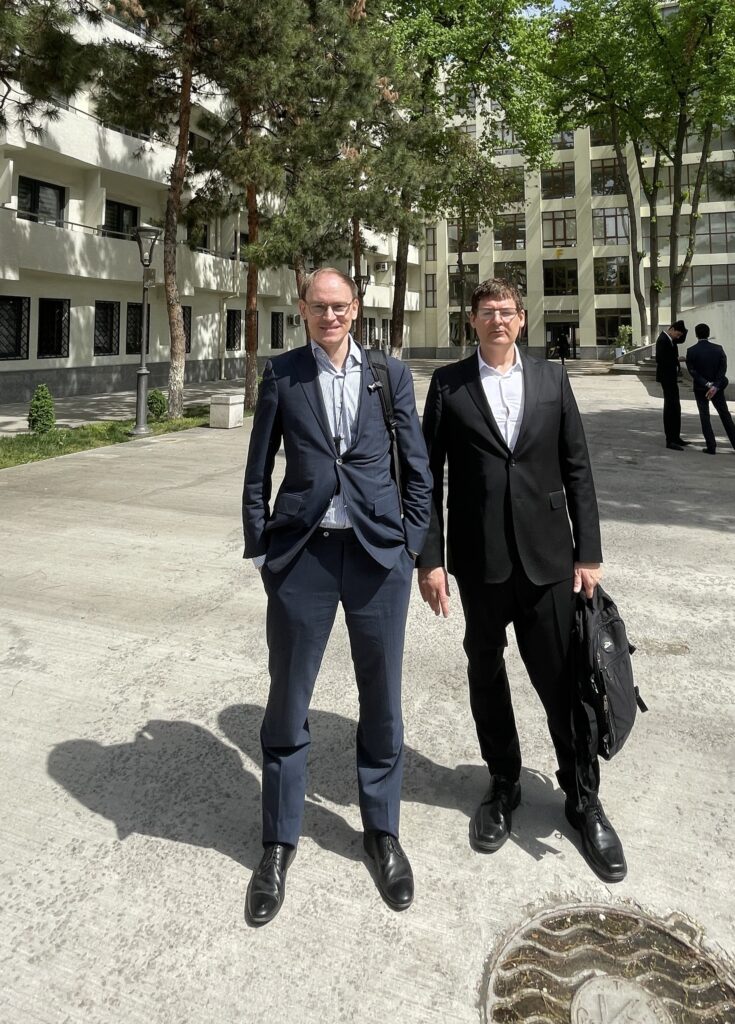
Field Studies in Uzbekistan 5-18 April 2025

Between 5–18 April 2025, I had the opportunity to conduct a research trip to Uzbekistan together with Dr Johan Engvall from the Stockholm Centre for Eastern European Studies (SCEEUS) at the Swedish Institute of International Affairs (UI).

During our visit, we engaged in productive discussions with several key institutions, including the International Institute for Central Asia, the Institute for Advanced International Studies at the University of World Economy and Diplomacy, the Development Strategy Center and the Center for Progressive Reforms. As part of the visit, we also took part in a round table discussion on the new security situation and EU-Central Asian relations hosted by the Center for Foreign Policy Studies.

We also travelled to the Autonomous Republic of Karakalpakstan, conducting a number of fruitful meetings with government officials as well as representatives from the Karakalpak State University. We also had the opportunity to visit the International Innovation Center for the Aral Sea Basin, learning about their work.

The visit provided valuable input for ongoing research and reinforced avenues for continued academic exchange. The discussions offered nuanced insights into Uzbekistan’s institutional priorities and strategic outlook, enriching our understanding of the evolving regional dynamics. We were met with a high level of openness and hospitality throughout, which greatly facilitated the depth and quality of our engagements. The meetings contributed substantively to shaping future lines of inquiry and collaboration.

International Society of MilitarySciences Conference 2024

From 10-12 September the Swedish Defence University is host for the International Society of Military Sciences (ISMS) Annual Conference 2024. This years theme is “Scaling up, Learning Lessons, Ensuring Quality.”

I am co-chairing WG 1: War Studies, Operations and Tactics with LtCol Dr Lars Henåker. The program contains a range of interesting papers and presentations on the themes WAR IN UKRAINE, OPERATIONAL ARTS AND STRATEGY, INFORMATION SPACE AND THE COGNITIVE FRONTIERS OF WARFARE, and HYBRID/PRIVATE/AI. Conference Program

I am presenting three papers:

“Reevaluating Urban Warfare: Lessons and Strategies from the Ukraine Conflict” co-authored with Prof. Douglas W. Winton of the Dwight D. David Eisenhower School for National Security and Resource Strategy, National Defense University, US.

“From Battlefield to Classroom: Incorporating War Games and Staff Rides in Professional Military Education (PME) to enhance Urban Combat preparedness” co-authored with
Major Jonas Björkqvist of the Land Operations Division, Department of War Studies, Swedish Defence University

“Operationalizing Psychological Defense: A framework for assessing, addressing and evaluating hybrid threats in democratic societies”, discussing the findings of the report Building Resilience and Psychological Defence – An analytical framework for countering hybrid
threats and foreign influence and interference
which I have co-authored with Björn Palmertz, Lund University Psychological Defence Research Institute, Docent Niklas Nilsson, Swedish Defence University and Dr Johan Engvall, Stockholm Centre for Eastern European Studies.

New book on Russian Warfare and Influence

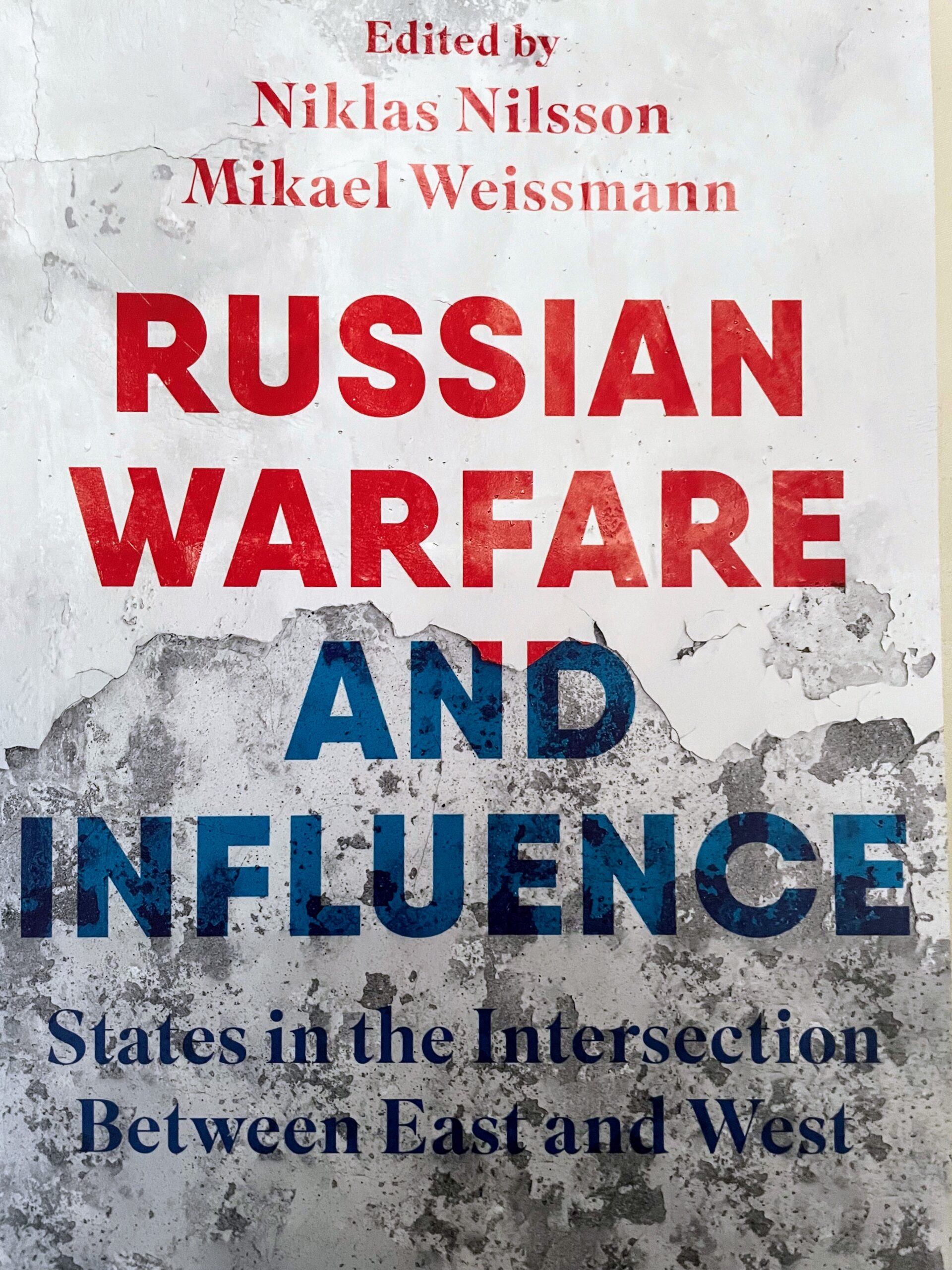
Our new book Russian Warfare and Influence: States in the Intersection between East and West by Bloomsbury Academic is out now! Buy it here https://www.bloomsbury.com/us/russian-warfare-and-influence-9781350335219/# or download it for free https://www.bloomsburycollections.com/monograph?docid=b-9781350335257&st=russian+warfare .

The book addresses the vulnerabilities of these countries to Russian influence and hybrid warfare tactics, as well as their responses to this security challenge. It includes a close examination of local developments in states such as Ukraine, Belarus, Finland, Armenia, Serbia and many others, analysing specific scenarios and practices, and draws on these observations to develop the current conceptual understanding of hybrid warfare as a phenomenon. Scholarship frequently focuses only on Russia and treats countries subjected to Russian hybrid measures as passive victims, thus providing an overly schematic picture of Russian behaviour. This book instead treats these states as actors in their own right, assessing their potential to address and counter the specific security problems arising from their geographic and political position.

Table of Contents

1. Russian warfare and influence: States in the proximity of Russia
Mikael Weissmann and Niklas Nilsson

2. Is it still hybrid? Russian aggression against Ukraine
Hanna Shelest

3. Does Russia need a hybrid Belarus policy?
Grigory Ioffe

4. Russia’s influence operations in the Baltic states
Janis Berzinš

5. The vulnerable little brother: Opportunistic partnership and Serbia’s exposure to Russia’s spoiler tactics
Vuk Vuksanovic

6. ‘Kosovo is Serbia’: A case study unpacking how Russia advances (shared) Russian and Serbian interests in the Balkans by shaping perceptions on Kosovo
Dorthe Bach Nyemann

7. Beyond cyber and disinformation: Russian hybrid warfare tactics in Georgia
Kornely Kakachia and Shota Kakabadze

8. Russia’s utilization of unresolved conflicts and proxy regimes
Niklas Nilsson, Johan Engvall and Mikael Weissmann

9. A diverse picture of Russian warfare and influence
Niklas Nilsson and Mikael Weissmann

Powered by WordPress & Theme by Anders Norén