Hybrid Threats | Psychological Defence | Strategic Intelligence | Technology & Defence | Modern Warfare | Urban Warfare | Staff Rides | Wargames | China and the Indo-Pacific | the Balkans | Central Asia

Category: Publication

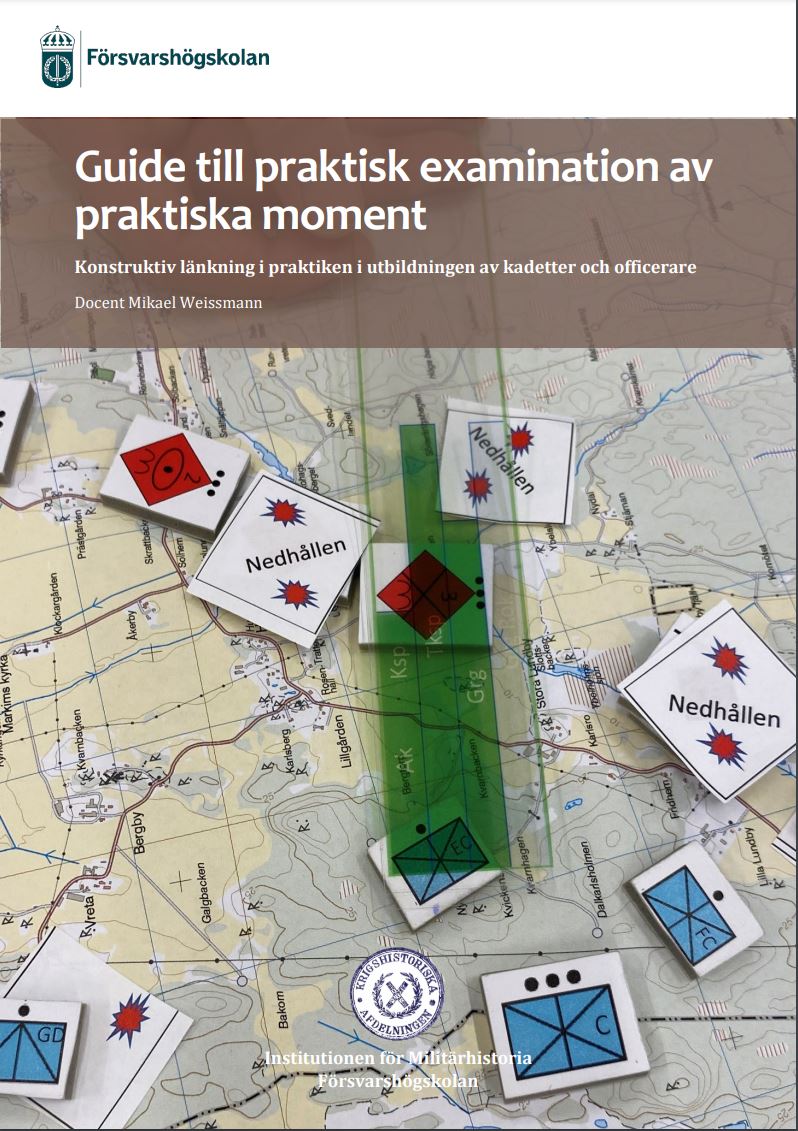
New Publication: Guide to Practical Examination of Practical Learning Activities in PME

I am pleased to share a recent publication I authored: Guide to Practical Examination of Practical Elements: Constructive Alignment in Officer Education.

This guide introduces a model that integrates learning objectives with practical activities and assessments in the training of officer cadets and senior officers within higher education. Its purpose is to demonstrate how constructive alignment can be applied in the practical teaching and assessment of cadets and officers, ensuring compliance with the standards of higher education examination while linking educational objectives, pedagogical activities, and evaluation methods. This approach enables the customization of practical assessments to reflect military professions’ dynamic and practical nature.

The book provides detailed models and examples, ranging from wargames to field exercises, making it an invaluable resource for those involved in officer education and military training.

Key topics include:

  • Constructive alignment in military education
  • Practical assessments for cadets and officers
  • Wargaming and scenario-based learning
  • Field exercises as educational tools

To learn more or access the guide, visit https://doi.org/10.62061/slep1008.

New chapter on the “The Impact of Future Threats on Intelligence and Security Services”

A new anthology on the Future of Intelligence and Security Services in Total Defence [Framtidens säkerhetstjänst i totalförsvaret] has been published by the Centre for Societal Security (CTSS) at the Swedish Defence University. This anthology aims to analyse how modern threat landscapes, new technologies, legislation, NATO membership, and the need for collaboration with other agencies and companies will impact the future operations of military security services and intelligence agencies. Written by some of Sweden’s leading experts in the field, the anthology seeks to describe the challenges facing military security and intelligence services as Sweden rebuilds its total defence and crisis preparedness.

My own contribution is a chapter on “The Impact of Future Threats on Intelligence and Security Services” explores the evolving nature of global security threats, focusing on the increasing complexity of hybrid threats and non-linear warfare. These threats employed by state as well as non-state actors, exploit the blurred boundaries between war and peace. The chapter highlights how traditional military superiority is being challenged by these unconventional methods, which combine cyberattacks, disinformation, and other tactics. It emphasises the need for intelligence and security services to adapt to this changing landscape by understanding and effectively countering these emerging threats.

My chapter can be downloaded here (in Swedish): https://fhs.diva-portal.org/smash/record.jsf?pid=diva2%3A1853875&dswid=-4422

The complete book can be downloaded here https://urn.kb.se/resolve?urn=urn:nbn:se:fhs:diva-12320 (in Swedish).

New book on Russian Warfare and Influence

Our new book Russian Warfare and Influence: States in the Intersection between East and West by Bloomsbury Academic is out now! Buy it here https://www.bloomsbury.com/us/russian-warfare-and-influence-9781350335219/# or download it for free https://www.bloomsburycollections.com/monograph?docid=b-9781350335257&st=russian+warfare .

The book addresses the vulnerabilities of these countries to Russian influence and hybrid warfare tactics, as well as their responses to this security challenge. It includes a close examination of local developments in states such as Ukraine, Belarus, Finland, Armenia, Serbia and many others, analysing specific scenarios and practices, and draws on these observations to develop the current conceptual understanding of hybrid warfare as a phenomenon. Scholarship frequently focuses only on Russia and treats countries subjected to Russian hybrid measures as passive victims, thus providing an overly schematic picture of Russian behaviour. This book instead treats these states as actors in their own right, assessing their potential to address and counter the specific security problems arising from their geographic and political position.

Table of Contents

1. Russian warfare and influence: States in the proximity of Russia
Mikael Weissmann and Niklas Nilsson

2. Is it still hybrid? Russian aggression against Ukraine
Hanna Shelest

3. Does Russia need a hybrid Belarus policy?
Grigory Ioffe

4. Russia’s influence operations in the Baltic states
Janis Berzinš

5. The vulnerable little brother: Opportunistic partnership and Serbia’s exposure to Russia’s spoiler tactics
Vuk Vuksanovic

6. ‘Kosovo is Serbia’: A case study unpacking how Russia advances (shared) Russian and Serbian interests in the Balkans by shaping perceptions on Kosovo
Dorthe Bach Nyemann

7. Beyond cyber and disinformation: Russian hybrid warfare tactics in Georgia
Kornely Kakachia and Shota Kakabadze

8. Russia’s utilization of unresolved conflicts and proxy regimes
Niklas Nilsson, Johan Engvall and Mikael Weissmann

9. A diverse picture of Russian warfare and influence
Niklas Nilsson and Mikael Weissmann

New report: Building Resilience and Psychological Defence

My latest report published by the Psychological Defence Research Institute’s Working Paper series is now available: Building Resilience and Psychological Defence.

It outlines an analytical framework, guidebook, and template addressing six dimensions of hybrid threats and foreign influence and interference from a nation-state perspective. Acknowledging that these types of threats are complex and multifaceted, it is intended to be an analytical starting point for government and non-government actors.

Co-authored with Björn Palmertz, Niklas Nilsson and Johan Engvall.

Full text available here: https://www.psychologicaldefence.lu.se/sites/psychologicaldefence.lu.se/files/2024-03/BuidlingResilienceAndPsychologicalDefence.pdf

New article: Current Intelligence and Assessments: Information Flows and the Tension between Quality and Speed

Just out in International Journal of Intelligence and Counterintelligence, article on “Current Intelligence and Assessments: Information Flows and the Tension between Quality and Speed”.

This article takes a particular interest in the dynamics between information flows, continuous ongoing assessments, intelligence dissemination, and forward-looking operational advice. The point of departure is the tension between balancing quality (in the sense of in-depth processing of large amounts of information) and speed (meeting requirements of timeliness) in current intelligence assessments. The article takes an explorative approach to practices in current intelligence, utilizing qualitative interview data combined with open source material.

NEW BOOK: Advanced Land Warfare: Tactics and Operations

My new co-edited volume on Advamced Land Warfare: Tactics and Operations is just out on Oxford University Press. Download full volume or chapters here: https://academic.oup.com/book/45784  (OPEN ACCESS)

The book:

  • Zeroes in on the evolving role of land forces, focusing particularly on the changes that have taken place in the art of commanding and executing combat and on the role of rapid technological innovation and information dissemination in shaping warfare
  • Revisits established military theory and thinking (some of it neglected in recent years) with lessons learned from contemporary land warfare
  • Provides various perspectives on key contemporary developments in land warfare, while also presenting case studies on land tactics and operations in different national contexts
  • Draws on the knowledge and insights of leading scholars of war and senior officers to provide a current understanding of the central issues of land warfare
  • Explores how land forces remain a crucial feature of warfare as evidenced by recent wars in Ukraine, Syria, Mali, Yemen and Nagorno-Karabak

Table of Contents

Foreword, Dr Meir Finkel
1:Approaching Land Warfare in the 21st Century, Dr Niklas Nilsson and Dr Mikael Weissmann
Part 1: Land Warfare
2:The Future of Manoeuvre Warfare, Dr Christopher Tuck
3:Commanding Contemporary and Future Land Operations: What Role for Mission Command?, Dr Niklas Nilsson
4:Combat Logistics in the 21st Century: Enabling the mobility, endurance, and sustainment of NATO land forces in a future major conflict, Dr Christopher Kinsey and Colonel Ronald Ti
5:The Command of Land Forces, Jim Storr
6:Tactical Tenets: Checklists or Toolboxes, BA Friedman and Henrik Paulsson
7:Urban Warfare: Challenges of Military Operations on Tomorrow’s Battlefield, Dr Mikael Weissmann
8:Emerging Technologies: From Concept to Capability, Dr Jack Watling
9:Interoperability Challenges in an era of Systemic Competition, Air Commodore (Rtd) Andrew Curtis
10:The moral component of fighting: Bringing society back in, Dr Tua Sandman
11:Military Health Services supporting the Land Component in the 21st Century, Gen (Rtd) Professor Martin CM Bricknell
Part 2: Case studies
12:The Operational Cultures of American Ground Forces, Dr Bruce I. Gudmundsson
13:1. People’s Liberation Army Operations and Tactics in the Land Domain: Informationized to Intelligentized Warfare, Brad Marvel
14:A Strategy of Limited Actions: Russia’s Ground-Based Forces in Syria, Dr Markus Balázs Göransson
15:The Role of Israel’s Ground Forces in Israel’s Wars, Dr Eado Hechet and Dr Eitan Shamir
16:Tactics and Trade-Offs: The Evolution of Manoeuvre in the British Army, Dr Alex Neads and Professor David J. Galbreath
17:Caught between a rock and a hard place: the French army, expeditionary warfare and the return of strategic competition, Dr Olivier Schmitt and Dr Elie Tenenbaum
18:Trends in the Land Warfare Capability of Poland and the Visegrad States, 1991-2021, Scott Boston
Conclusions
19:Towards a versatile edge: Developing land forces for future conflict, Dr Mikael Weissmann and Dr Niklas Nilsson

En handbok om fältövningar

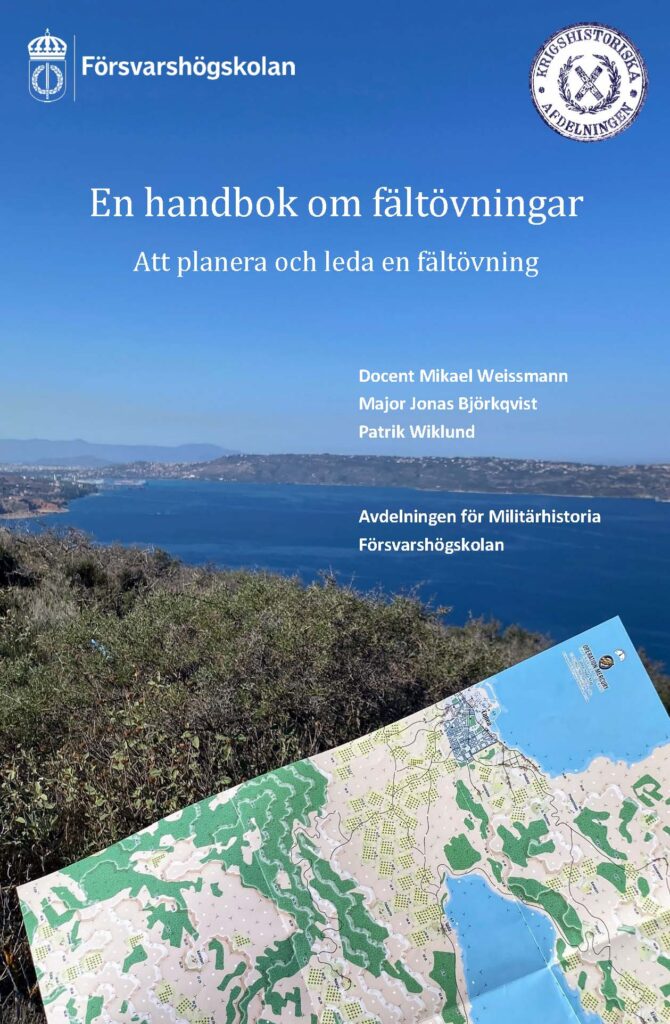
I just published a handbook on planning and conducting staff rides in Swedish titled En handbok om fältövningar: Att planera och leda en fältövning.

The full text can be downloaded here: https://doi.org/10.5281/zenodo.7655034  The Swedish text is a development of our peer-reviewed English article “Staff Rides as a Pedagogical Tool in Professional Military Education (PME): Planning and Conducting Historical Staff Rides” in the Journal on Baltic Security available here

Abstract:
Praktiska pedagogiska redskap är en central del i utbildningen av officerare. Detta är ett område där det finns en lång tradition, både på Försvarshögskolan och inom Försvarsmakten mer generellt. Detta är också ett område där Försvarshögskolan alltid har varit framträdande, där metoder som applikatoriska exempel (applex), krigsspel, fältövningar, stabstjänstövningar och taktiska problem under lång tid har använts. Denna handbok riktar in sig på ett av dessa pedagogiska redskap: fältövningar. 

Handboken är disponerad som följer: först ges en historisk bakgrund till fältövningar och vi diskuterar vad en fältövning är och vilka typer som finns. Därefter flyttar fokus till tankar kring att planera och genomföra en fältövning. Här diskuterar vi planeringsfasen, lärdomar kring nyttan av att rekognosera inför genomförande och tankar kring fältövningens pedagogiska genomförande. Handboken avslutas med en diskussion kring hur man bör tänka när man planerar och genomför en fältövning, både praktiskt och pedagogiskt. Här presenteras även en schematisk modell kring fältövningens pedagogiska dynamik för olika målgrupper baserat på deras förförståelse och olika fältövningars komplexitet.


New Article on Staff Rides as a pedagogical tool

 My new peer-reviewed article on “Staff Rides as a Pedagogical Tool in Professional Military Education (PME): Planning and Conducting Historical Staff Rides” has just been published in Journal on Baltic Security. It has been co-authored by Major Jonas Björkqvist and Patrik Wiklund at the Swedish Defence University.

Abstract:
The use of various practical pedagogical tools is an important part of officer training. This is also an area where there is a long tradition in the training of officer cadets and officers in staff colleges as well as in the Armed Forces more generally. This article focuses on staff rides aimed at teaching tactics and operational arts based on historical examples. This type of staff-rides aims to learn from history with a bearing on the present and the future.

The article is organized as follows: first, the article gives a short overview of the history of staff rides, followed by a discussion on different types of staff rides. Then the focus shifts to ways to plan and carry out a staff ride. This includes the planning phase, reconnaissance, and the different pedagogical tools that can be used and their implementation. The article concludes with a discussion of how to think when planning and carrying out staff rides, both practically and pedagogically. The article here presented a schematic model of the pedagogical dynamics of the staff ride for different target groups based on their pre-understanding and the complexity of different field exercises.

Citation:
Weissmann, Mikael, Jonas Björkqvist, Patrik Wiklund, “Staff Rides as a Pedagogical Tool in Professional Military Education (PME): Planning and Conducting Historical Staff Rides”, Journal on Baltic Security 8(2022), no. 2, 61-82. FULL TEXT

Page 2 of 2

Powered by WordPress & Theme by Anders Norén